Dual Language Interview Series: Katarina Brito

In School Year 2016-2017, DCPS will have dual language at 11 schools with new programs at Houston Elementary School, MacFarland Middle School, and Roosevelt High School. We’ve heard a lot of interest from parents across the city about these programs, and will start sharing some information about plans to expand bilingual education at DCPS over the coming months.

We got to sit down with Katarina Brito, a Dual Language Developer in DCPS’ Language Acquisition Division, to talk about dual-language in DCPS! Katarina got her start with us after teaching in California and now works to provide high-quality bilingual education to a growing number of DC Public School students.

10325340_1688486641422526_2925345665329531060_n

School Planning: What do Dual Language programs look like at DCPS?

Katarina Brito: All of our programs are Spanish-English dual language programs; they’re fifty-fifty models which mean that at least fifty percent of instruction is offered in the non-English language starting at kindergarten. Within the fifty-fifty model, there’s another model that is known as “two-way immersion”, where kids who speak both languages learn together in the classroom. There are also one-way programs, in which a majority of students speak English or the non-English language. In DCPS we have all of those models; Tyler Elementary has 90% English speaking kids and a few Spanish-speakers, Powell is 85% Spanish-speaking, and most of our other schools are a mix of Spanish- and English-dominant students – all with half of the instruction in English and half in Spanish.

One thing that’s important to emphasize is that our dual-language schools, no matter the model, all have the same four goals: bilingualism (speaking fluently in two languages), biliteracy (reading and writing in two languages), academic achievement, and cultural competency. Those are our driving forces whenever we’re making decisions. We ask ourselves, “How does this change that we’re making bring us closer to meeting or exceeding our goals?”

Within our schools we have a lot of variety. For example, a school might switch the language of instruction by week, day, half-day, or even classroom. We have a set of non-negotiables which makes sure we have stability in place to meet our goals. In fact, we were just complimented in an article in New America, which highlighted how the dual-language programs at DCPS are particularly responsive to their communities, which calls attention to why we have so many models across the District.

School Planning: Is there data that supports dual-language education models?

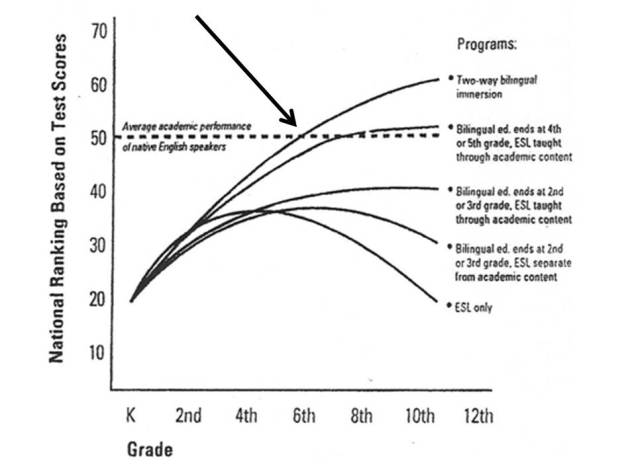
Katarina pointed us to some research done on elementary and middle school students, which shows that dual-language programs can provide major benefits for native English-speakers and non-native English-speakers. English Language Learners (ELLs) in dual-language tend to have higher test-scores than students in English-Only programs, and English dominant students in dual-language programs tend to perform at or above the level of peers in English-only classrooms. Additionally, dual-language students show higher rates of self-esteem and self-confidence, drop out of school at lower rates, and experience a smaller achievement gap between English-learners and English dominant students.
 

Slide1

Thomas and Collier research results: 40,000 ELLs, proficiency on standardized tests in English. The arrow indicates at about 6th grade, English Language Learners in two-way bilingual immersion begin to perform better academically than the 50th percentile of native English speakers.

School Planning: How have parents and communities responded to Dual-Language?

KB: They’re hugely popular among both English Language Learners and English-dominant students. All of this information has come out on the benefits of bilingualism, and families, especially English-speaking families, are excited to immerse their children in such a program and to have their kids develop second-language proficiency.

We also have a sizable number of students who speak another language at home, like Vietnamese or Amharic, and they’re participating in the dual-language program as well, so they’re actually becoming trilingual.

School Planning: What are some of the biggest obstacles facing Dual-Language in DCPS?

KB: There are big obstacles, but there used to be huge obstacles. We’ve been able to find creative ways around staffing and now have no teaching vacancies in any of our schools. We’ve been able to make this possible through partnerships with foreign countries and recruiting from Puerto Rico and the rest of the US. DCPS is really building a name for itself, so people are coming to us after hearing about our programs. Materials are another issue because we’re working within a system that is designed for English instruction, so there’s a need to be creative to make sure we have appropriate and adequate materials in the non-English language.

Additionally, all of the DCPS Dual-Language schools have just been combined into one cluster, which means that they are grouped together and run by one superintendent. This means that all the DL schools can learn from each other, ask questions based on experience, and provide each other resources that they wouldn’t have had otherwise. It’s been really powerful.

School Planning: Are DL programs being piloted anywhere else in the country?

KB: Yes. There’s a huge upswing of DL programs in the nation because of all the research and articles which have come out, proving the benefits of bilingualism. Places like Oregon, and North Carolina are on the cutting edge. In the state of Utah, the governor has committed to opening 100 dual language programs in the year and the state of Delaware is doing the same. California, Texas, and New Mexico all have strong programs as well. It’s popping up everywhere.

School Planning: How do dual-language programs integrate “cultural competency” in schools?

KB: Last year was our first year to offer the Seal of Biliteracy award to high school students who can prove bilingualism and biliteracy. To get the Seal, students have to prove that they’ve taken coursework in English, taken coursework in the non-English language, and have evidence of a cultural competency activity. For example, one recipient did an internship in Mandarin, one student did volunteer work in a French-speaking country, and another went to baseball camp in the Dominican Republic.

The award serves as well-earned recognition for these students that have continued their bilingualism beyond their dual-language programs. It really shows that these programs can have an impact beyond the years students are enrolled in DL programs. We want to keep kids motivated to pursue their dual-language fluency.

School Planning: Is there anything else you’d like the DCPS community to know about dual language programs?

KB: In 2005, there were maybe 500 kids in DL and this year we have 3000 plus. There’s a lot of talk about how there aren’t enough programs out there, but we’ve expanded six-fold. We also didn’t used to have early-childhood, we didn’t used to have high school or middle school programs and now we have it from Pre-K through 12th grades. We’ve grown a great deal over the past ten years and are continuing to explore where we go from here.

MacFarland and Roosevelt Community Cabinet Meeting Notes

Both the Roosevelt and the MacFarland Community Cabinets met the last week of June to wrap up a school year’s worth of work on their neighborhood schools. The Roosevelt Cabinet discussed a number of updates regarding school facilities, uniforms, and an introduction of new administrators. MacFarland Cabinet members discussed facility updates and weighed in on how MacFarland should brand and market itself as a neighborhood school with both dual language and comprehensive programs. It was especially helpful to have parent representatives from all DCPS elementary schools with both dual language and comprehensive tracks.

Principal James even closed us out with a nice little surprise! Much needed on an approximately one billion degree afternoon. Thank you to all our Cabinet members for a year of hard work — we can’t wait to see what the next year holds for your neighborhood schools! Find the Roosevelt notes HERE, and MacFarland notes HERE.

Welcome to MacFarland, Mr. Sanders!

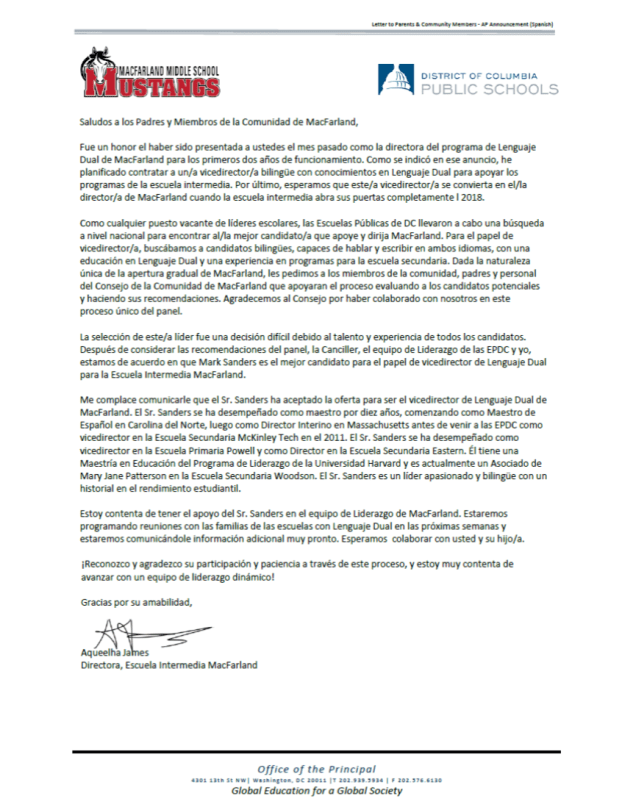
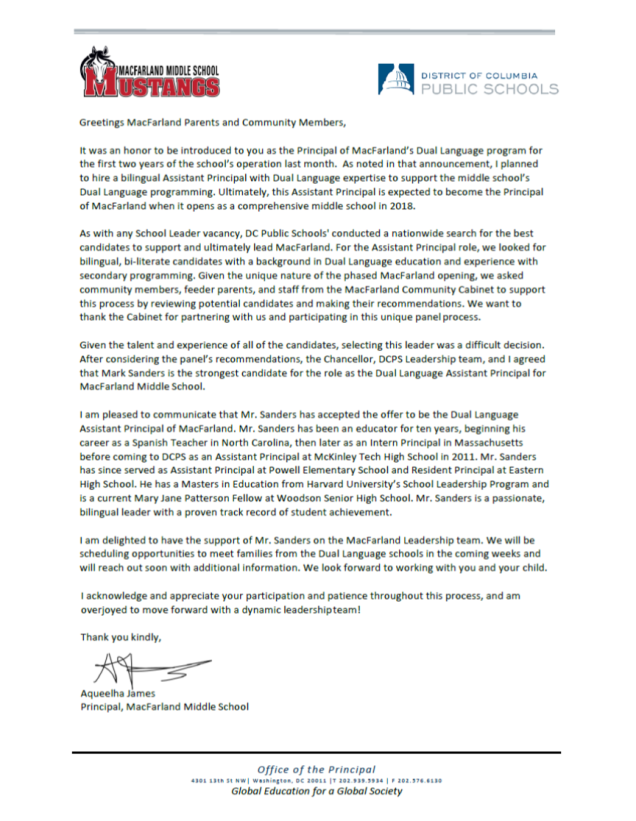
MacFarland community members, we’ve got some exciting news on MacFarland leadership! As you may recall, Roosevelt Principal Aqueelha James will be Principal of MacFarland for the next two years with the support of a bilingual Assistant Principal. In early April DCPS asked a group of community members, parents, and MacFarland Community Cabinet members to meet the candidates for MacFarland AP and make a recommendation to the Chancellor. We’re happy to announce today that the panel’s recommendation, Mark Sanders, has accepted an offer to join MacFarland’s leadership team!

Mr. Sanders has a ten year track record of success as a bilingual educator, starting out as a Spanish teacher and serving as Assistant Principal at McKinley Tech High School and Powell Elementary School. He has a Masters in Education from Harvard University’s School Leadership Program and is a current Mary Jane Patterson Fellow at Woodson Senior High School.

Mark Sanders

The full announcement in English and Spanish is below. We’ll be announcing opportunities to meet your new MacFarland leadership team soon. Stay tuned!

050616 MacFarland AP announcement ENG050616 MacFarland AP announcement SPAN


MacFarland Leadership Announcement

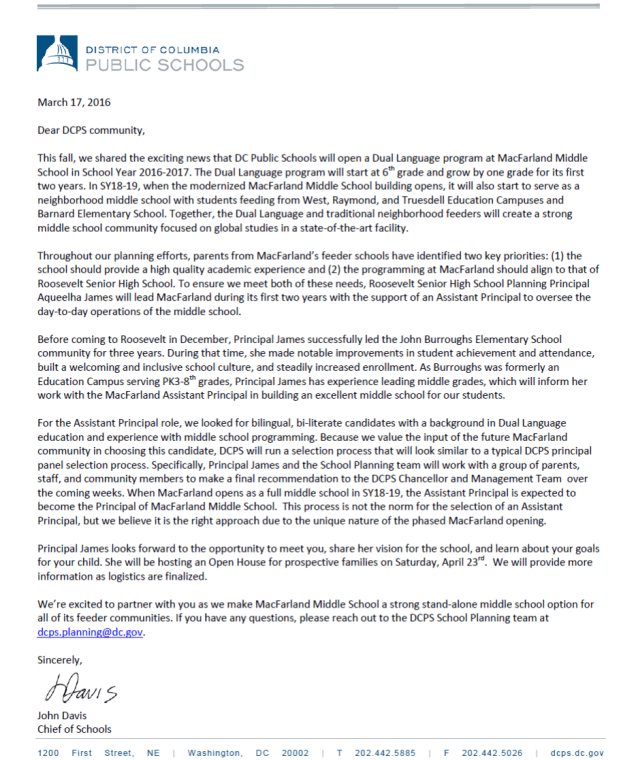
Below is the letter  announcing MacFarland Middle School’s leadership structure from DCPS Chief of Schools John Davis. The full announcement was sent home to our feeder families last week; the key idea is that Roosevelt High School Planning Principal Aqueelha James will lead MacFarland during its first two years with the support of a bilingual, biliterate Assistant Principal with dual language expertise to oversee the day-to-day operations of the middle school. We’re excited to start enrollment on April 1st!

032116 MacFarland letter English032116 MacFarland letter Spanish

Why Choose MacFarland?

Dual Language families, see the below presentation we’ve been sharing with families at our dual language elementary schools about MacFarland Middle School over the past several months. The highlights:

  • MacFarland is opening with a 6th grade dual language program in August, about 4 blocks north of the Georgia Ave/Petworth metro station. All students in DCPS dual language programs have a guaranteed seat.
  • In years past, most DCPS dual language students have left bilingual programs before they get to middle school — MacFarland gives families a guaranteed opportunity to continue learning in two languages.
  • All the research shows that students who continue in bilingual education have better outcomes in reading and math than those who leave dual language.
  • MacFarland’s program is based on the Oyster Adams middle school model. Students take English Humanities and Spanish Humanities. Math is taught in English, Science is in Spanish. Students take an enrichment block to get extra help in a language or learn a third language.
  • DCPS is piloting a global education program at MacFarland next year — both global education and dual language will align with programming at Roosevelt High School.
  • The deadline to reserve your seat is Tuesday, March 1st — submit your application for MacFarland Dual Language right away!

Open the presentation below for more detailed information, including the process for how MacFarland will grow from 6th grade dual language program to full 6-8 middle school.

Still have questions? Contact us at DCPS.Planning@dc.gov.

022616 MacFarland Meeting with Parents

MacFarland February Event Schedule

The My School DC lottery deadline countdown is ticking away to the March 1st deadline for middle schools! To make sure our parents are as informed as possible about options for dual language middle school, we’ll be out at our feeder schools and in the community throughout the month of February to talk about MacFarland Middle School’s 6th grade Dual Language Program, opening this August 2016.

Interested parents and students are invited to join us at any of the times below:

  • Thursday, February 4th – Powell Elementary School table at drop-off – 8 to 9am
  • Thursday, February 11th – Ward 4 Education Alliance meeting at Takoma EC – 6:30 to 8:30pm
  • Thursday, February 11th – Information Session at Bancroft ES – 6 to 7pm
  • Wednesday, February 17th – Marie Reed ES tabling session – 8 to 9am
  • Tuesday, February 23rd – Bruce Monroe information session with 5th grade students and parents – 8:30 to 9:30am
  • Wednesday, February 24th – Information session at Tyler ES – 6 to 7pm
  • Thursday, February 25th – General Information Session at the Petworth Library – 6 to 7pm
  • Friday, February 26th – Bruce Monroe PTU Meeting – 9 to 10am

We’ll be updating this list with more dates and times to make sure we reach all of our feeder communities (Cleveland coming soon) and interested parents before the March 1st deadline. Please reach out to DCPS.Planning@dc.gov with any questions in the meantime.

McFarlandMustangsLogoFINAL-01


MacFarland Community Cabinet Notes

The MacFarland Community Cabinet met on Monday, January 11th to discuss global education at MacFarland and in DCPS in general. DCPS Director of Global Education Kate McNamee was unable to attend, but we added a few responses from her to questions we weren’t able to answer at the meeting. Those responses are tagged in the right-hand column with “Kate follow-up response”.

The presentation is also attached below. Next meeting: February 17th.

011115 MacFarland Community Cabinet Meeting Notes

MacFarland Community Cabinet Global Studies Presentation

Tuesday Follow-Up: How does MacFarland Guarantee Work?

We got this question at our meeting at Powell on Tuesday, 11/3 and wanted to follow up:

“How does the guarantee work for students in dual language programs at DCPS elementary schools? Are they guaranteed a spot regardless of where they rank MacFarland in the lottery? If they match with another school they rank higher, do they lose the guarantee?”

Answer:

The “guaranteed right” to MacFarland means students from dual language programs at DCPS elementary schools will be guaranteed a seat at MacFarland as long as they apply in Round 1, rank MacFarland as one of the schools on their application, and are not matched with a school they ranked higher. As is the case with all other applications, if they are matched at a school they ranked higher, they will not be waitlisted for MacFarland and will no longer have a guaranteed right to the school.

In other words, the surest way to secure the guaranteed seat is to rank MacFarland #1 on your first round lottery application. If you rank other schools above MacFarland, a match with any of those more highly ranked schools will forfeit the guaranteed seat at MacFarland.

Questions? Contact DCPS.Planning@dc.gov.

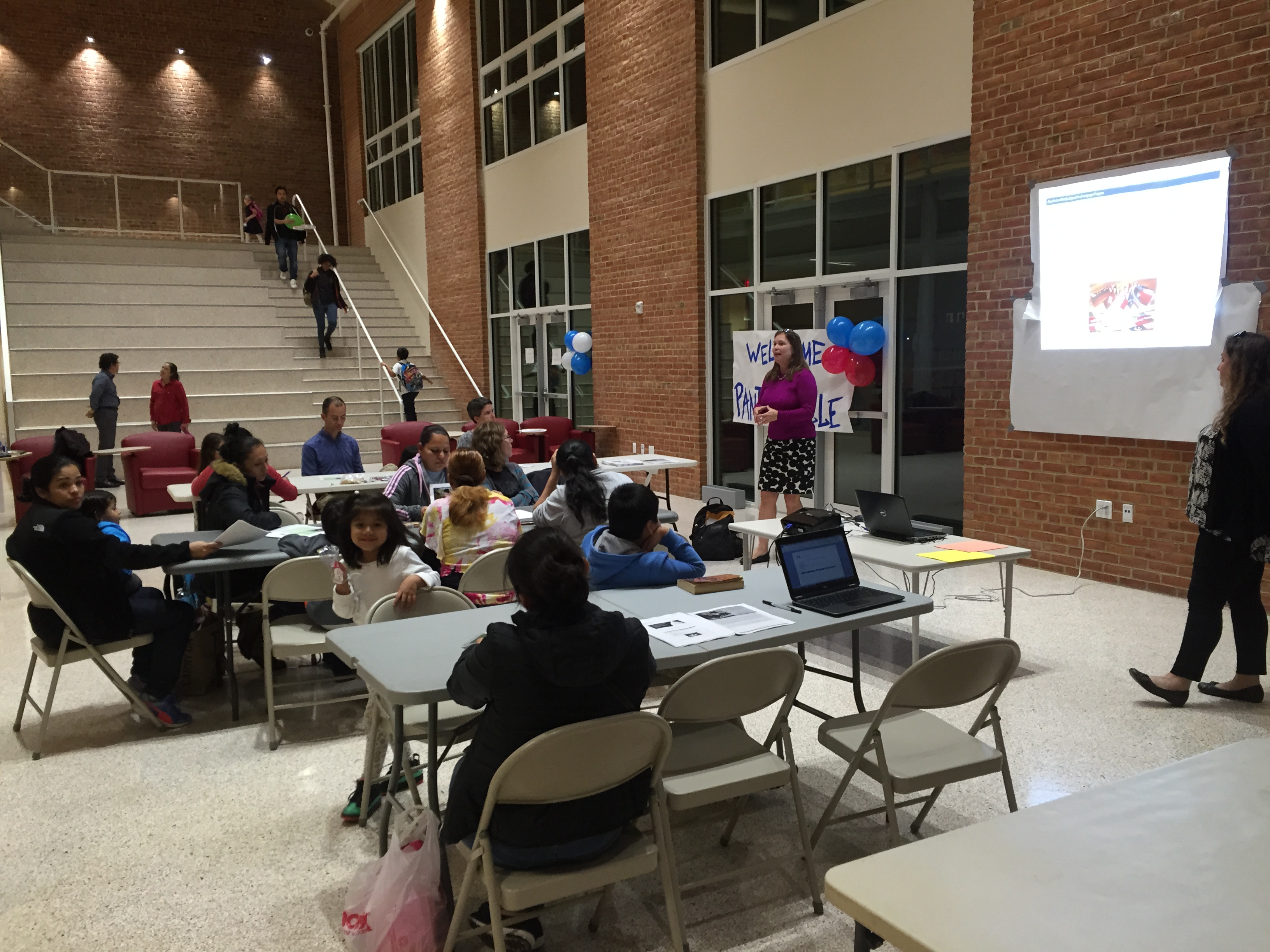
110315 MacFarland at PowellKatarina Brito (top, purple) and Rosanna de Mammos (right) from DCPS’ Language Acquisition Division discuss MacFarland’s Dual Language Program with parents at Powell Elementary School on Tuesday, 11/3.

MacFarland Community Cabinet — 10/27 Meeting Notes

Thanks to our MacFarland Community Cabinet for a thoughtful discussion on a vision for the school. Notes and supporting documents are below.

102715 MacFarland Community Cabinet Meeting Notes

102715_MacFarland Community Cabinet_Meeting 2_Vision Discussion Capture Sheet